kato-Special Features


Pioneer Zephyr
Courtesy of Griffin Museum of Science and Industry, Chicago
In 1934, as America struggled through the depths of the Great Depression, a train unlike anything seen before emerged as a bold vision of the future.
The development of the Zephyr was an ambitious undertaking, representing a determined effort to revitalize the railway industry during one of the most challenging periods in its history. Manufactured by the Budd Company for the Chicago, Burlington & Quincy Railroad (CB&Q), the Burlington Zephyr became the world's first stainless-steel streamliner. The train remained in regular service for approximately 26 years, until its retirement in 1960.
As the precursor to the many high-speed Zephyr trains that followed and a pioneering example of stainless-steel railway construction, it later became known as the Pioneer Zephyr. Today, it is preserved at the Museum of Science and Industry in Chicago, where it continues to tell its remarkable story and inspire visitors from across the United States and around the world.
This Autumn, KATO will release a 1/160 N-scale model of the “Pioneer Zephyr” using our refined technologies. Discover its fascinating history and product details below!
November 2026 Release
CB&Q Pioneer Zephyr
Chicago Burlington & Quincy Railroad
Pioneer Zephyr
106-101
$199.00
History
Railway Recovery from the Great Depression
The global economic depression that began in 1929 had a major impact on American railroads. At the time, steam locomotives dominated railway travel, but their need for coal, water, facilities, and support staff made them expensive to operate. Due to the economic downturn, passenger numbers decreased sharply. Furthermore, with the expansion of automobiles and airplanes, railroads were rapidly losing their position. Amid these circumstances, railway companies were being called upon to implement fundamental reforms in order to rebuild passenger transportation.
The Burlington Zephyr
Courtesy of Griffin Museum of Science and Industry, Chicago
In response to this challenge, the Chicago, Burlington & Quincy Railroad (CB&Q) introduced the Burlington Zephyr. This new type of railcar, which combined a lightweight stainless-steel body with a diesel engine, was capable of addressing two long-standing problems faced by conventional railways: high operating costs and an outdated image. The trainset used articulated bogies, enabling high-speed yet stable operation. Its streamlined exterior completely changed how people thought about trains, creating the powerful impression of a “train of the future.

▲The Pioneer Zephyr on Display at the Chicago World's Fair
In 1934, a record-run event called the “Dawn-to-Dusk Run” was carried out. Covering a distance of approximately 1,633 kilometers from Denver to Chicago, the train completed the journey in 13 hours and 5 minutes—entirely within daylight hours. For the time, this was an astonishing achievement, with an average speed of about 124 km/h and a top speed of 181 km/h. Crowds gathered along the line to witness the spectacle, which became a striking demonstration of modern rail technology. The Burlington Zephyr’s success soon made it a national sensation.

FUN FACT
The Meaning Behind the Name "Zephyr"
The name "Zephyr" is derived from Zephyrus, the god of the west wind in Greek mythology. Associated with a gentle, refreshing breeze, the name perfectly captured the image of a new generation of lightweight, high-speed trains.
The choice of name also carried a deeper significance. CB&Q president Ralph Budd deliberately sought a name beginning with the letter "Z", the last letter of the alphabet. At a time when many believed the golden age of railroading was drawing to a close, the name reflected his determination to create a train that would usher in a new era for the industry.
Among numerous candidates, the name Zephyr was ultimately selected, becoming one of the most iconic names in American railroad history.

Courtesy of Griffin Museum of Science and Industry, Chicago
The Naming Ceremony at Broad Street Station
Great Success and What Followed
After its debut, the Burlington Zephyr was used in test operations and promotional runs in various locations, generating significant public attention. Its advanced performance and design captured people’s interest and helped rekindle enthusiasm for railways. Starting in November of the same year, it began regular service as a scheduled train operating between Lincoln, Omaha, and Kansas City. Passenger numbers also increased, and its positive impact became clearly evident in business performance.
In response to this success, the company went on to introduce a series of successor trains known as the “Zephyr” series. While many Zephyr trains were named after geographic locations along their routes, others adopted more symbolic names, such as “Silver Streak,” highlighting their streamlined, futuristic image. As multiple Zephyr trains came into operation, the original trainset was later given the name “Pioneer Zephyr.” Other railway companies also introduced similar streamlined diesel trains, and in the United States, the so-called “streamliner era” began. As a forerunner, the Pioneer Zephyr became a landmark that opened up a new era in rail transportation.

Courtesy of Griffin Museum of Science and Industry, Chicago
Among the various Zephyr trains, some have already been released as models by KATO (KATO USA).
Silver Streak Zephyr

The Silver Streak Zephyr entered service in 1940 on the route between Lincoln, Omaha, and Kansas City.
Prior to its introduction, the Pioneer Zephyr operated on this service as a four-car articulated train with an additional coach attached. As passenger demand increased, however, greater capacity became necessary, leading to the development of a new trainset.
Unlike the Pioneer Zephyr, the Silver Streak Zephyr used conventional bogie trucks rather than an articulated design. This reflected a broader shift in Zephyr development, moving away from the lightweight, fixed-formation philosophy of the early streamliners toward a more practical design that allowed cars to be added or removed as operational needs changed.
While many Zephyr trains were named after the regions they served, "Silver Streak" refers to a "streak of silver," a nod to the train's distinctive stainless-steel appearance.
The name was inspired by The Silver Streak, a film based on the Pioneer Zephyr's famous Dawn-to-Dusk Run, in which the train itself played a central role.
California Zephyr
Introduced in 1949, the California Zephyr was a premier long-distance streamliner connecting Chicago with the San Francisco Bay Area (Oakland).
Operated jointly by the Chicago, Burlington & Quincy (CB&Q), Denver & Rio Grande Western (D&RGW), and Western Pacific (WP), the train traversed some of the most spectacular scenery in North America, including the Rocky Mountains and the Sierra Nevada. Its breathtaking route earned it a reputation as one of America's most beautiful trains.

Covering nearly 4,000 km (2,500 miles) in approximately two days, the California Zephyr offered a comfortable and memorable travel experience. Its distinctive consist of sleeping cars, coaches, and dome cars quickly became an icon of postwar American rail travel.
The California Zephyr is also one of the few Zephyr trains whose name lives on today. Now operated by Amtrak, it continues to run over much of the original route between Chicago and the San Francisco Bay Area (Emeryville), using stainless-steel Superliner equipment. More than 75 years after its debut, the train's legacy remains an enduring part of American railroad history.

FUN FACT
Older Than Japan’s "D51"?
When the Pioneer Zephyr made its debut in 1934, steam locomotives still dominated railways around the world.
In Japan, it was the year before production began on the D51 Class steam locomotive, affectionately known as the "Degoichi," which would go on to become the most numerous steam locomotive class ever built in the country. Even in the United States, famous steam giants such as the legendary Big Boy had yet to appear. The first Big Boy locomotives would not enter service until 1941.
In other words, the Pioneer Zephyr was already pointing the way toward the future of rail transportation before many of the world's most famous steam locomotives had even been born.


▲Click here for the Big Boy website!
The Innovation of All-Stainless-Steel Railcars
The Budd Company
The Budd Company was an American manufacturer that expanded into railway vehicles using the techniques it had pioneered in the automobile industry. In particular, it played a major role in the practical application of stainless-steel carbody construction. The company’s “Shotweld” process was an innovative technology for efficiently joining stainless steel, making it possible to manufacture car bodies that were both lightweight and highly durable.
Thanks to this technology, not only the exterior panels but even the main structural framework of the cars could be made entirely of stainless steel, making “all-stainless-steel railway vehicles” possible. Compared with conventional steel railcars, these vehicles were lighter, highly resistant to corrosion, and easier to maintain—truly a groundbreaking development.
The train born from this innovation was the Burlington Zephyr, later known as the Pioneer Zephyr, introduced in 1934.
Courtesy of Griffin Museum of Science and Industry, Chicago

▲A demonstration of the train's lightweight construction, with ten people pulling the all-stainless-steel consist
Pioneer III and the Pioneer III Bogie
The Budd Company continued its development of lightweight stainless-steel railcars, and in the 1950s announced a new concept for lightweight passenger cars and electric multiple units, or EMUs, known as “Pioneer III.” A prototype was completed in 1956, and in 1958 it was put into practical use as an electric train on the Pennsylvania Railroad, or PRR. One of its distinguishing features, the “Pioneer III bogie,” combined a lightweight structure using small-diameter wheels with a high level of ride comfort. This bogie went on to exert a significant influence on later railway vehicle design.
Note: The name "Pioneer" was used by the Budd Company to designate a series of groundbreaking technological developments. The company's stainless-steel flying boat was known as Pioneer I, while the diesel powerplant developed for the Pioneer Zephyr was considered Pioneer II. Continuing this tradition, Pioneer III became the designation for Budd's next-generation lightweight passenger car and EMU concept, introduced in the 1950s.
_JPG.jpg)
レール工房ひげしん 銭谷政彦
▲Pioneer III Bogie (as used on Tokyu Corporation's 7000 Series)

レール工房ひげしん 銭谷政彦
▲The exposed disc brake, a characteristic feature of the Pioneer III bogie, as seen on a Nankai 6000 Series train
Expansion and Development in Japan
Budd Company’s stainless-steel carbody technology was eventually introduced to Japan as well.
Tokyu Car Corporation (Tokyu Sharyō Seizō) signed a technical partnership agreement with the Budd Company in 1959 (Showa 34) and, based on this technology, developed domestically produced stainless-steel railcars. In 1962 (Showa 37), the Tokyu 7000 series was introduced as Japan’s first domestically produced all-stainless-steel train. In the same year, the Nankai 6000 series—Kansai’s first all-stainless-steel train—was also introduced.

▲Tokyu Series 7000 (Item No. 10-1305)

▲Nankai Electric Railway 6000 Series (Item No. 10-2100)

レール工房ひげしん 銭谷政彦
▲Plaque commemorating the technical cooperation agreement with the Budd Company, displayed inside the car and on the bogie
These trains incorporated the principles of the Pioneer III bogie, achieving both reduced weight and improved ride comfort, and they made a significant contribution to the development of commuter trains in Japan. Although Budd Company’s railway vehicle manufacturing division was later sold off, in Japan the technology it introduced became the foundation for the independent development of what came to be known as “lightweight stainless-steel construction methods.”
Over time, this technology was further improved and refined, and today it has evolved into a variety of construction methods, with many railway vehicles being manufactured and operated using all-stainless-steel bodies.
8%E4%B8%A1%E3%82%BB%E3%83%83%E3%83%88_side.jpg)
▲JNR 205 Series

▲JR East E235 Series(sustina)
Back to Today
The Pioneer Zephyr remained in active service for approximately 26 years, until 1960. Today, it is preserved on display at the Museum of Science and Industry in Chicago, where it continues to share its history and influence with audiences in the United States and around the world.
Product Information / Prototype
.jpg)
106-101
CB&Q Pioneer Zephyr
CB&Q Pioneer Zephyr 3-Unit Set
$199.00
€205.00 (incl. 19% VAT)
£180.00 (incl. 20% VAT)

The Pioneer Zephyr in N Scale
Coming this Autumn, KATO’s 1/160 N-scale Pioneer Zephyr brings this legendary streamlined diesel train to life with the precision and craftsmanship developed through years of model railway production. The model faithfully recreates key features of the original, including its articulated bogie structure and distinctive stainless-steel finish.
This model recreates the original three-car trainset as it appeared at the time of its debut, including the configuration used for the famous “Dawn-to-Dusk Run.” It also matches the form of the train currently preserved at the Museum of Science and Industry in Chicago.
Each car features a different body length and bogie spacing, giving the Pioneer Zephyr its distinctive profile.

Car No. 1 / #9900
Car No. 1 is the powered car, equipped with a diesel engine. Rather than being a separate locomotive, it also includes interior space for mail and baggage.
The model faithfully reproduces the car’s distinctive exterior, including the rows of spot-like weld marks created by Budd Company’s proprietary Shotweld process, as well as the uniquely curved front-end design.
・Headlight illuminates when running forward
・Designed to allow installation of a DCC sound speaker
Car No. 2
Car No. 2 is the intermediate car, combining mail and baggage space with a buffet and passenger seating area. Despite its short body length, it served multiple functions, giving it a particularly unique layout.

.jpg)
Car No. 3
This is the rear car, equipped with a passenger seating area and an observation compartment.
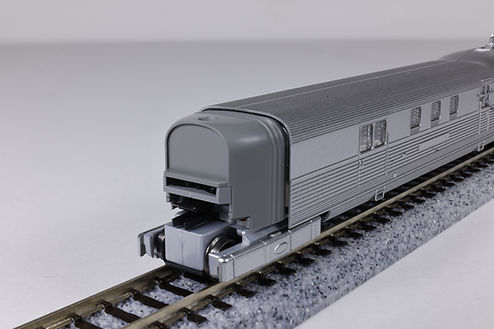
・Faithfully reproduces the Pioneer Zephyr's distinctive corrugated stainless-steel bodywork and unique metallic texture.
・Car No. 3 features illuminated tail lights and a functioning backup light, replicating reverse-operation lighting used on the prototype.
・Accurately models the train's characteristic articulated construction with Jacobs bogies.
・Bogie side covers enhance the seamless appearance of the complete trainset.
・Special coupling design allows easy separation and reconnection of cars for convenient storage and handling.
・Realistically detailed gangway sections and bogie covers reproduce the appearance of the prototype between coupled cars.
.jpg)
.jpg)
.jpg)
Coming this Autumn!
All rights reserved. 1998-2026 株式会社カトー / 株式会社関水金属Unauthorized use or reproduction of photos and contents is forbidden.