kato-Special Features


Michel Grannec
1964
HISTORY
01
of the First-Generation TGV Sud-Est
From luxury international trains to high-speed rail

The golden era of the TEE
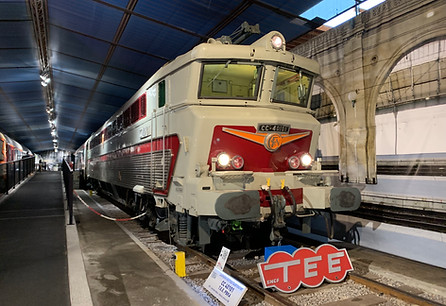
In 1967, to compete with the rapidly developing post-war aviation and automobile industries, Western Europe began operating the international express trains known as TEE (Trans Europ Express), which connected major cities across the continent.
Luxurious trains befitting the highest-class service of each country quickly appeared. For example, Germany’s Rheingold and France’s Étoile du Nord, running between Paris and Amsterdam—each one admired with journeys everyone dreamed of experiencing at least once.
These prestigious trains raced across Europe, captivating passengers far and wide.
In 1961, the Swiss Federal Railways introduced the RAe II Gotthard, the first electric train to serve as a TEE. In 1989 KATO produced a scale model of this iconic train!
Connecting Paris and Lyon:
At the heart of the cities connected by the TEE network stood none other than the “City of Light” — Paris. Among the TEE connections, the route between Paris — the capital of France — and Lyon, its second-largest city, was one of Europe’s most important main lines.
Demand on this route remained high both day and night. During the day, it was served by SNCF’s flagship express train, the TEE Le Mistral; at night, by the Train Bleu, the original Blue Train. As intended, rail demand continued to grow. However, the line was approaching its limits in both capacity and speed due to its already congested schedule.
Then, from across the globe, came groundbreaking news...
The Arrival of the 0 Series Shinkansen

On 1st October 1964, the Tokaido Shinkansen Line was officially opened, along with the first ever Shinkansen or “bullet train” (0 Series). Connecting Tokyo and Shin-Osaka, this marked the launch of the world’s first commercial “Dream Super Express,” reaching a top speed of 210 km/h. With its streamlined, aircraft-like design and iconic ivory-white and blue livery, this pioneering train made a huge impact worldwide.
The Series 0 Shinkansen,
preserved at the UK’s National Railway Museum
Inspired by the success of Japan’s high-speed trains, the movement to develop faster trains gained serious momentum worldwide. In particular, the French National Railway Company (SNCF) undertook a detailed study of the Shinkansen and began work on a system to surpass it — including both the development of next-generation high-speed trains and the construction of entirely new high-speed rail lines.
These high-speed lines were named LGV (Ligne à Grande Vitesse), and the trains operating on them were called TGV (Train à Grande Vitesse). The relationship between the line and the train is similar to that of the Tokaido Shinkansen Line and the 0 Series trains — a system in which both infrastructure and vehicles were developed in tandem.
The first LGV route chosen for construction was, of course, the crucial Paris–Lyon corridor. This section was named the LGV Sud-Est, with Sud meaning “South” and Est meaning “East” in French.

1957
TGV and LGV
A Vital Link in France’s Rail Network
1972
"A plane without wings" : The Birth of the TGV

TGV001
In 1972, the prototype for what would become the TGV — the TGV 001 — was unveiled. It used a gas turbine engine system for propulsion, and on December 8 of that year, it set a world speed record at the time by reaching 318 km/h.
With its unprecedented speed, rounded aerodynamic design, and striking orange body, the TGV 001 gave people a glimpse of “the train of the future.”
1978

Michel Grannec

Michel Grannec

The completion of the TGV Sud-Est
In 1978, in the wake of the 1970s oil shocks, the gas turbine propulsion system had to be abandoned. Instead, a new electric locomotive system was adopted — and from this shift, the TGV Sud-Est was born.
The first two pre-production trainsets, Unit 001 and Unit 002, were nicknamed “Patrick” and “Sophie.” The trains featured a distinctive configuration: two electric locomotives at either end (M1 and M2), with eight intermediate passenger cars (R1–R8) in between. Unlike the distributed power system of the Shinkansen, the TGV adopted a concentrated power system, where only the end cars provided propulsion.
Additionally, the lead cars were equipped with couplers, enabling two trainsets to be joined together — allowing for 20-car operations when needed.

The Opening of the LGV Sud-Est Line
On 27th September 1981, the LGV Sud-Est Line was officially opened, and the TGV Sud-Est made its full-fledged debut as a new high-speed train.
Its maximum operating speed was 260 km/h. On the busy Paris–Lyon route, double-heading was used to operate impressive 20-car trainsets, achieving great success in both speed and passenger capacity.
1981
Michel Grannec
Extra!

The 380 km/h breakthrough
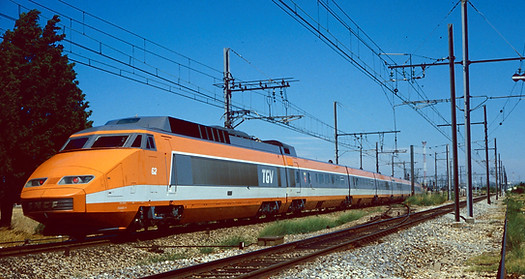
In pursuit of a new world speed record, high-speed test runs were conducted on 26th February 1981, prior to the start of commercial operations. The train reached an astonishing 380 km/h — a remarkable achievement that stunned the world.
TGV Sud-Est trainset No. 016 was specially modified for these tests. The number of passenger cars was reduced to five, and both the gear ratios and overhead line voltage were adjusted for high-speed operation. The groundbreaking speed couldn’t even be monitored on the speedometer in the driver’s cab, which maxed out at 280 km/h — a striking reminder of how unprecedented the challenge truly was.
“It felt as if the train had taken off and was flying high above the Atlantic and Mediterranean.”
“Before I even had a chance to look at the scenery outside, it quickly disappeared behind the train window one after another."
”Torn between nostalgia for the steam locomotive and admiration for this wingless airplane that passed by faster than I could even gasp, I was overwhelmed with tears.”
Michel Grannec
Those who witnessed the test watched the train rush past, sensing the dawn of a new era.
2011
1996
Performance beyond its time

International Debut
Following the start of commercial service, demand continued to grow steadily, and the TGV Sud-Est fleet was rapidly expanded. In just six years from its debut, a total of 111 trainsets were produced. In addition to the dual-voltage domestic version (Class 22000), a tri-voltage version (Class 33000) was also introduced. These were used for international services to Switzerland, which required compatibility with different power systems.
Among the international-spec 33000 series trainsets, Set No. 112 stood out as particularly unique. Because it had been leased long-term to the Swiss Federal Railways (SBB), the front-end “SNCF” logo — representing the French National Railways — was painted over in orange, and an “SBB” logo was added to the sides to indicate Swiss operation. The sight of France’s iconic orange TGV adorned with the red-accented logo of the Swiss Federal Railways proudly symbolized the moment when the TGV began crossing borders and establishing itself as an international train service.

The World's Fastest Mail Train — the Yellow TGV “La Poste”
In October 1984, the French National Railways (SNCF) signed a contract with La Poste, the French postal service, to convert a TGV into a dedicated mail train. This led to the creation of the world’s first and fastest high-speed postal train: the TGV “La Poste.”
Based on the modified Set No. 38, the train was painted entirely in the same bright yellow as France’s mailboxes and operated for nearly 30 years as a “moving post office.”

From Orange to Silver Blue: A new look for the TGV brand
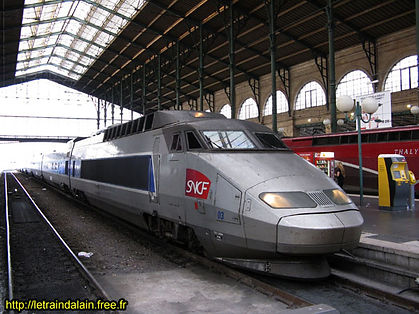
In 1996, with the opening of the new LGV Atlantique line, the TGV Atlantique — the successor to the TGV Sud-Est — was introduced.
This marked a turning point for the TGV brand, prompting a redesign of its look. The logo was updated, and the classic orange livery was replaced with a sleek silver and blue scheme. To match its newer counterpart, the TGV Sud-Est fleet was also repainted in the same silver and blue colors.

30 Years in Operation — The Arrival of the “Carmillon” Livery
Time moved on, and by 2011 — 30 years after the start of TGV commercial operations — the network had expanded significantly, and many new TGV models had been introduced.
That same year, SNCF undertook a brand-wide redesign, not just for the TGV, but for the company as a whole. The updated design language adopted a modern and elegant urban aesthetic called “Carmillon”, a blend of carmine red and vermilion.
TGV Sud-Est trainsets were also repainted in this new livery. However, with many of the sets showing signs of aging after three decades of service, their gradual retirement began in 2012.
Retirement of the TGV Sud-Est
The Sud-Est continued to serve for nearly 40 years, changing its roles and liveries as the years passed. But finally, the time came for its retirement. Yet, as a pioneer and key player in the development of high-speed rail, this legendary train remained irreplaceable in the hearts of many.
2020
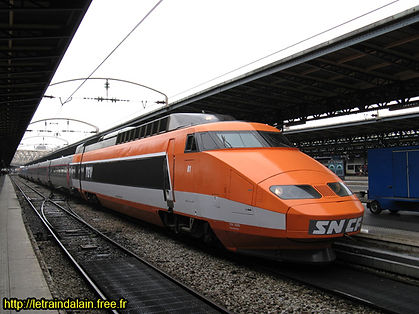

In its final year, 2020, Set No. 001—nicknamed “Patrick,” which had retired the previous year—made a celebrated return to Lyon station, sporting the three iconic liveries that symbolized its 40-year history, bringing enthusiasts together from around the world.
1984
Photo Peter Huerzeler Collection
Preservation of the First Generation TGV
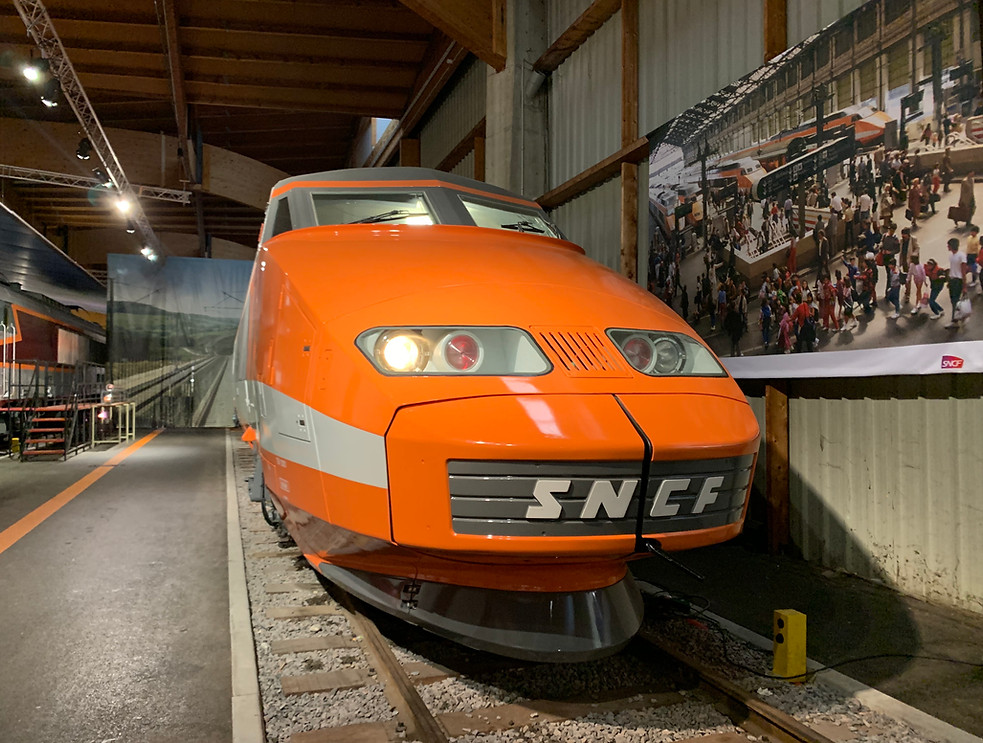
The original TGV is now widely recognized as a key pioneer of Europe’s high-speed rail network. At France’s largest railway museum, the Cité du Train, it has been restored to its iconic orange livery. Even today, it continues to honor and share its remarkable legacy in the history of rail transport.
NEXT

Michel Grannec

All rights reserved. 1998-2024 株式会社カトー / 株式会社関水金属
★ コンテンツ・写真等の無断転載を禁じます ★